
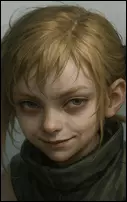



Permission, Nozomi had learned, was its own form of currency. The seal on the authorization scroll still felt just as warm as the first time Nozomi unrolled it beneath the quiet lanternlight of her room. Kitsune’s signature was sharp and decisive, pressed into the parchment with a certainty that felt almost surgical. This would grant her access to the inner archives, access to the protected records, and most importantly, access to the linguistic vaults of Classical Kumogakurean. Nozomi had bowed when such permission was handed to her and she promised to study for the village, its future, and her own.
Her fingers trembled again now as she stood at the edge of The Bibliotheca Conscientiae. There was an electricity here that hummed overhead like static crawling through the wiring behind polished walls. The air in this place carried the smell of chalk, paper, and ink. She was walking into the marrow that this village's structure was built around and she could not help but look in awe of the glass partitions that stood beside stone pillars that were carved centuries ago.
Nozomi appreciated such contrast.
She presented her seal at the threshold, pale eyes steady, and watched the guards verify its legitimacy with quiet efficiency. Doors unlocked, not with creaking hinges, but with muted metallic clicks. Inside, shelves rose in measured rows and documents were catalogued by era, by political epoch, but mostly by crisis.
She took her time and began with governance. Kumogakure was not merely ruled by a Raikage, that was merely a simplification.
The deeper records revealed cycles, consolidation of power during wartime, and distribution of such power to councils during reconstruction. The Cloud Council itself wasn't just a ceremonial body. It was engineered in eras of instability to prevent a single point of collapse. After all, in clouds history there had been coups, near-coups, and quiet reassignments of authority masked as reform. Even something as simple as the timeline of Raikages and Sennin was less a succession and more a heartbeat that told of the rise, collapse, recovery, and recalibration of their home.
Nozomi made sure to trace through those names with careful eyes and an open mind. Authority in Kumogakure was architecture, and architecture could be dismantled. She attempted to memorize not just names, but patterns within the system. Things like when ANBU branches expanded, how internal security tightened, and even when external conflicts forced ethical compromises. The rise of the Kingslayer incidents revealed that myths were not merely stories but they held dangerous truth that could turn into a catalyst.
History here had a cyclical undertone, and she would do her best to document it accordingly.
Legal systems came next.
The laws of Kumogakure were written plainly. It was made clear that there was a rank structure with appropriate assignments. It defined punitive measures and defined treason. It even delved into proper protocol for Kinjutsu and detainment of those who break these laws. The next protocol was for execution, and they were lines that Nozomi read over very carefully. It became very clear to Nozomi that this village did not forbid growth in power, but it did regulate such things.
Above all, what struck her strange were the things conditionally permitted. Research, wild experimentation, and interrogation practices were all allowed but bound by defined thresholds and procedures. There was a comforting fact to Nozomi that ethics in Kumogakure seemed to be bound by measurable worth of the outcome and that morality seemed to be an ambiguous thing.
What struck her most was not what was illegal, but what was conditionally permitted. Research, provided it served the village. Experimental methods, provided authorization was secured. Interrogation practices, bounded by defined thresholds. This gave permission for her and Rei to potentially walk very close to forbidden lines so long as they maintained proper foresight.
Geography unfolded next across annotated maps. Lightning Country was made up of provinces layered in political nuance. The Holy Tenouzan Republic is a culturally distinct province with religious undertones threading through governance. Where Bear Marsh is isolated, stubborn, and resilient to liberal forces. Nozomi would note how geography influenced strategy as she found mineral veins, ore, alloys, and other rare deposits dictate the requirement for military expansion into those areas.
Nozomi began to study terrain not as scenery, but as the true variable it could become in the future. Where could she disappear, or where would such shadows betray her? She noted regions where chakra signatures were historically weak, regions where bloodlines clustered, and most importantly, regions where rebellion had previously formed.
This tied directly into Lightning Country's declining number of chakra users. Nozomi analyzed clinical reports of population data, bloodline dilution, and other noted environmental factors. The village's pressure to cultivate power and necessity to constantly recruit, made even more sense.
All of this was reading though was simple preparation for the true work that began when she stepped into the linguistic wing.
The script of Classical Kumogakurean was sharper than its Vulgar counterpart, angular and severe. Characters formed with deliberate stroke order that altered meaning if miswritten. Grammar that layered context within inflection rather than position and verb structure that folded temporal nuance into single glyphs.
It would take time, but Nozomi approached this study with patience and reverence. She began with phonetics. Slowly understanding the constructed vowel shifts across centuries. She began to compare pre-war inscriptions to post-war reforms and memorized patterns that dictated whether a statement was command, prophecy, or supplication.
This was no easy task, and weeks would pass with this taking up the majority of each day. Soon, her daily routine became a ritual of sorts. In the morning she would review and compare translations from Classical to Vulgar in governance documentation across years of time. In the afternoon she would practice her penmanship and transcribe documentation for hours on end. Then, even after she left the library and returned to the Ryuu Farms, she practiced pronunciation under her breath until syllables began to feel natural coming from her lips.
Every day, she copied stone rubbings of inscriptions from the Ancient Vault and cross-referenced them against modern translations. She even discovered that some “prophecies” had been mistranslated. That certain passages were not warnings, but technical descriptions. In her version of the translation something like 'madness' might more accurately translate to 'overextension of coil.' Her pulse would quicken at discoveries like that, and she found that this language could hold truths within syntax that were still not completely understood.
It took an immense amount of time and patience but she even began to understand the structural shifts between ceremonial dialect and administrative dialect. How things like legal contracts differed linguistically from spiritual oaths. There was one thing that kept her interest piqued throughout this process, and it was an ancient concept which implied worship, but she found something different. Nozomi believed the implication was exchange, a nuance that was microscopic and yet it could change everything.
Her mind processed the information in clinical fashion and she wrote until her wrists ached. Charts began to form in her notebooks in an attempt to cross reference between Ryuu lineage accounts and Kumogakurean military expansions. Especially attempting to note any information regarding chakra coil anomalies recorded centuries prior to such terminology being established. She did not allow emotion to cloud the interpretation of any of these documents, and yet she could not help but feel something tighten within her ribs as she read of individuals marked by anomalous coils whose power became unstable or destabilized completely.
By the end of the second month, she could read Classical Kumogakurean without hesitation. Her accent was imperfect, but her comprehension was surgical and she no longer had to rely on modern annotations. As such, she utilized her permission to gain deeper access within The Ancient Vault. Here, stone corridors replaced polished tile and the lighting relied on older technology, fuel based lanterns. Even the air here smelled older and her authorization needed to be verified an additional time for access.
The vault contained pre-Council records and documentation predating standardized governance. Tablets referencing entities labeled simply as Gods but the formulation of the words were very different. Perhaps it wasn't meant to be Gods, but Ancients or Spirits or Demons... she wasn't quite sure yet. Here she began searching for intersections of the Ryuu Lineage, any references to the Ashura Blade or things that may have predated it or any of its sisters. She would focus on copying and translating information on chakra coil irregularities and any mentions of rituals that would bind a soul to an object within the confines of experimental theology.
She did not find answers, because that is not how searching historical text works, but she did find fragments and threads that can be pulled at in the future. There were minor notations on universal chakra modulation and the blackening of the mind following amplification of the coil, this would intrigue Nozomi greatly.
Additional weeks would be spent translating carefully to extract and help refine the structure of how to understand the nuance of Classical Kumogakurean. She would see patterns beginning to align but she did not fully comprehend how they would form or what it meant. Still, she needed to find answers, for herself, for Rei, and for all the Ryuu. So, she would continue to study night and day with an unmatched fervor to perfect her understanding of this ancient language.
Her fingers trembled again now as she stood at the edge of The Bibliotheca Conscientiae. There was an electricity here that hummed overhead like static crawling through the wiring behind polished walls. The air in this place carried the smell of chalk, paper, and ink. She was walking into the marrow that this village's structure was built around and she could not help but look in awe of the glass partitions that stood beside stone pillars that were carved centuries ago.
Nozomi appreciated such contrast.
She presented her seal at the threshold, pale eyes steady, and watched the guards verify its legitimacy with quiet efficiency. Doors unlocked, not with creaking hinges, but with muted metallic clicks. Inside, shelves rose in measured rows and documents were catalogued by era, by political epoch, but mostly by crisis.
She took her time and began with governance. Kumogakure was not merely ruled by a Raikage, that was merely a simplification.
The deeper records revealed cycles, consolidation of power during wartime, and distribution of such power to councils during reconstruction. The Cloud Council itself wasn't just a ceremonial body. It was engineered in eras of instability to prevent a single point of collapse. After all, in clouds history there had been coups, near-coups, and quiet reassignments of authority masked as reform. Even something as simple as the timeline of Raikages and Sennin was less a succession and more a heartbeat that told of the rise, collapse, recovery, and recalibration of their home.
Nozomi made sure to trace through those names with careful eyes and an open mind. Authority in Kumogakure was architecture, and architecture could be dismantled. She attempted to memorize not just names, but patterns within the system. Things like when ANBU branches expanded, how internal security tightened, and even when external conflicts forced ethical compromises. The rise of the Kingslayer incidents revealed that myths were not merely stories but they held dangerous truth that could turn into a catalyst.
History here had a cyclical undertone, and she would do her best to document it accordingly.
Legal systems came next.
The laws of Kumogakure were written plainly. It was made clear that there was a rank structure with appropriate assignments. It defined punitive measures and defined treason. It even delved into proper protocol for Kinjutsu and detainment of those who break these laws. The next protocol was for execution, and they were lines that Nozomi read over very carefully. It became very clear to Nozomi that this village did not forbid growth in power, but it did regulate such things.
Above all, what struck her strange were the things conditionally permitted. Research, wild experimentation, and interrogation practices were all allowed but bound by defined thresholds and procedures. There was a comforting fact to Nozomi that ethics in Kumogakure seemed to be bound by measurable worth of the outcome and that morality seemed to be an ambiguous thing.
What struck her most was not what was illegal, but what was conditionally permitted. Research, provided it served the village. Experimental methods, provided authorization was secured. Interrogation practices, bounded by defined thresholds. This gave permission for her and Rei to potentially walk very close to forbidden lines so long as they maintained proper foresight.
Geography unfolded next across annotated maps. Lightning Country was made up of provinces layered in political nuance. The Holy Tenouzan Republic is a culturally distinct province with religious undertones threading through governance. Where Bear Marsh is isolated, stubborn, and resilient to liberal forces. Nozomi would note how geography influenced strategy as she found mineral veins, ore, alloys, and other rare deposits dictate the requirement for military expansion into those areas.
Nozomi began to study terrain not as scenery, but as the true variable it could become in the future. Where could she disappear, or where would such shadows betray her? She noted regions where chakra signatures were historically weak, regions where bloodlines clustered, and most importantly, regions where rebellion had previously formed.
This tied directly into Lightning Country's declining number of chakra users. Nozomi analyzed clinical reports of population data, bloodline dilution, and other noted environmental factors. The village's pressure to cultivate power and necessity to constantly recruit, made even more sense.
All of this was reading though was simple preparation for the true work that began when she stepped into the linguistic wing.
The script of Classical Kumogakurean was sharper than its Vulgar counterpart, angular and severe. Characters formed with deliberate stroke order that altered meaning if miswritten. Grammar that layered context within inflection rather than position and verb structure that folded temporal nuance into single glyphs.
It would take time, but Nozomi approached this study with patience and reverence. She began with phonetics. Slowly understanding the constructed vowel shifts across centuries. She began to compare pre-war inscriptions to post-war reforms and memorized patterns that dictated whether a statement was command, prophecy, or supplication.
This was no easy task, and weeks would pass with this taking up the majority of each day. Soon, her daily routine became a ritual of sorts. In the morning she would review and compare translations from Classical to Vulgar in governance documentation across years of time. In the afternoon she would practice her penmanship and transcribe documentation for hours on end. Then, even after she left the library and returned to the Ryuu Farms, she practiced pronunciation under her breath until syllables began to feel natural coming from her lips.
Every day, she copied stone rubbings of inscriptions from the Ancient Vault and cross-referenced them against modern translations. She even discovered that some “prophecies” had been mistranslated. That certain passages were not warnings, but technical descriptions. In her version of the translation something like 'madness' might more accurately translate to 'overextension of coil.' Her pulse would quicken at discoveries like that, and she found that this language could hold truths within syntax that were still not completely understood.
It took an immense amount of time and patience but she even began to understand the structural shifts between ceremonial dialect and administrative dialect. How things like legal contracts differed linguistically from spiritual oaths. There was one thing that kept her interest piqued throughout this process, and it was an ancient concept which implied worship, but she found something different. Nozomi believed the implication was exchange, a nuance that was microscopic and yet it could change everything.
Her mind processed the information in clinical fashion and she wrote until her wrists ached. Charts began to form in her notebooks in an attempt to cross reference between Ryuu lineage accounts and Kumogakurean military expansions. Especially attempting to note any information regarding chakra coil anomalies recorded centuries prior to such terminology being established. She did not allow emotion to cloud the interpretation of any of these documents, and yet she could not help but feel something tighten within her ribs as she read of individuals marked by anomalous coils whose power became unstable or destabilized completely.
By the end of the second month, she could read Classical Kumogakurean without hesitation. Her accent was imperfect, but her comprehension was surgical and she no longer had to rely on modern annotations. As such, she utilized her permission to gain deeper access within The Ancient Vault. Here, stone corridors replaced polished tile and the lighting relied on older technology, fuel based lanterns. Even the air here smelled older and her authorization needed to be verified an additional time for access.
The vault contained pre-Council records and documentation predating standardized governance. Tablets referencing entities labeled simply as Gods but the formulation of the words were very different. Perhaps it wasn't meant to be Gods, but Ancients or Spirits or Demons... she wasn't quite sure yet. Here she began searching for intersections of the Ryuu Lineage, any references to the Ashura Blade or things that may have predated it or any of its sisters. She would focus on copying and translating information on chakra coil irregularities and any mentions of rituals that would bind a soul to an object within the confines of experimental theology.
She did not find answers, because that is not how searching historical text works, but she did find fragments and threads that can be pulled at in the future. There were minor notations on universal chakra modulation and the blackening of the mind following amplification of the coil, this would intrigue Nozomi greatly.
Additional weeks would be spent translating carefully to extract and help refine the structure of how to understand the nuance of Classical Kumogakurean. She would see patterns beginning to align but she did not fully comprehend how they would form or what it meant. Still, she needed to find answers, for herself, for Rei, and for all the Ryuu. So, she would continue to study night and day with an unmatched fervor to perfect her understanding of this ancient language.