
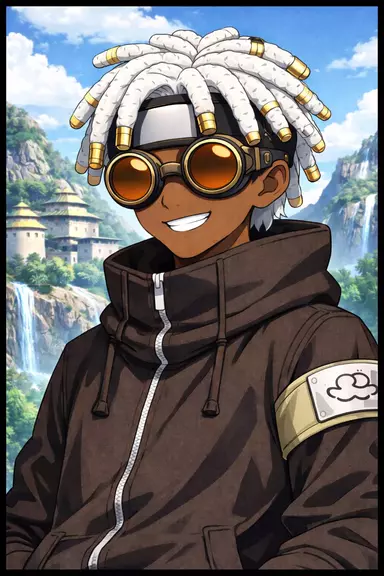

Name: Sugaru Dayu
Age: 11
Gender: Male
Sex: Male
Rank: Academy Student
Bloodline/Core ability: Aburame
Physical Description:
White dreads cascade down to Dayu's shoulders, each loc threaded with gold metallic beads that catch and fracture sunlight during outdoor training. The contrast is striking, pale hair against rich brown skin that darkens to deep umber during summer months spent under Cloud Village's mountain sun.
Dark goggles hide his eyes completely. Behind the tinted glass, his black eyes can observe without betraying reaction. Can study. Can calculate. The goggles have become as much a part of his identity as the insects living beneath his skin.
His signature garment is a brown high-collar hoodie. The fabric is thick enough to obscure the subtle movements beneath his skin when the Kikai shift and settle. The hood itself can be pulled up to create a shadowed space, a mobile shelter that moves with him through the streets. White pants and black sandals complete the practical outfit.
His Cloud headband wraps around his left bicep rather than his forehead, the metal plate polished to a mirror sheen that reflects his diligent maintenance. At twelve years old, his build is exactly average for an Academy student, neither the muscular development of a taijutsu specialist nor the leaner frame of pure chakra practitioners. His body reflects his approach: balanced, unremarkable, strategically positioned in the middle of every measurable spectrum.
His hands disappear into his hoodie pockets with practiced frequency. The gesture appears casual, habitual, but serves a specific purpose: concealing the rippling movement of insects beneath his skin during moments of heightened emotion. When deep in thought, his fingers emerge to play with the gold locks in his dreads, twisting and untwisting the metal threading in unconscious patterns.
There's nothing intimidating about Dayu's physical presence. At a glance, he's simply another Academy student. Average height, average build, unremarkable except for the distinctive hair and ever-present goggles. The kind of twelve-year-old boy who could disappear into a crowd of his peers and emerge unnoticed on the other side.
Mental Description:
Dayu's mind operates on two parallel tracks that rarely intersect.
The external track projects confidence with practiced precision. This is the mental space where he calculates appropriate responses, moderates his tone, selects which emotions to display and which to bury. It's the careful architecture of someone who learned early that perception shapes reality, that appearing confident generates actual confidence in others, and that reputation can be constructed through deliberate behavioral patterns maintained over time. This is where charisma lives, not as natural gift but as studied skill.
The internal track runs a constant anxiety protocol that never fully shuts down. It catalogs potential failures with obsessive detail. Every interaction feeds data into an endless analysis loop that searches for evidence of inadequacy, finds it even when it doesn't exist, and files it away as proof that he's not measuring up to invisible standards he can't quite define.
These two tracks create a peculiar cognitive dissonance. He knows his strategic thinking surpasses most of his peers. He knows Tomoe's friendship is genuine and his father's pride is real. The external track processes this evidence clearly. But the internal track dismisses it as irrelevant, insisting that competence isn't enough, that good isn't acceptable when excellence is expected, that any gap between current performance and theoretical perfect performance represents failure.
The insects living beneath his skin respond to this internal state with unsettling accuracy. When anxiety peaks, they become more active, shifting, crawling, pressing against the inside of his skin in ways that become visible to careful observers. It's an involuntary tell that undermines his carefully constructed confident exterior, a biological truth that his mental performance can't fully override.
What prevents complete paralysis is genuine intellectual curiosity that operates independently of both tracks. When presented with a puzzle, something else activates. The anxiety quiets. The performance drops away. His mind engages with pure problem-solving focus that feels qualitatively different from both the external confidence and internal doubt. In these moments, tracking a target through broken terrain or analyzing an opponent's fighting pattern, he experiences something approaching flow state. The insects settle. His breathing regulates. He understands, with crystalline clarity, why his father chose this path.
Buried deeper than anxiety, hidden beneath layers of practical consideration and dutiful discipline, lives a dream he's labeled as frivolous: music. Not as hobby or stress relief, but as purpose. Playing violin in distant cities, traveling to places he's only encountered in books, making a living through beauty rather than duty. The dream surfaces during late-night practice sessions when his bow moves across strings and his mind constructs elaborate fantasies: concert halls in distant countries, audiences of strangers, a life built on want rather than should.
He never speaks this dream aloud except to Tomoe, and even then he wraps it in dismissive language. Calls it silly. Impractical. A childish fantasy that has no place in a ninja's mental landscape. The external track recognizes that acknowledging the dream means acknowledging the choice he's already made to bury it. The internal track uses it as evidence of inadequacy, that his dedication is contaminated by selfish desire, that he's failing before he's even begun.
But the dream persists anyway. Stubborn. Quiet. Waiting in the spaces between duty and sleep.
History:
The insects came first, before memory, before language, before the concept of choice had any meaning. His father made the decision on the day of his birth. Practical, traditional, advantageous. Sugaru Masato was a Jounin in Kumogakure's counter-intelligence division, and the Kikai had served him well for decades. Why wouldn't he give his firstborn son the same tool?
Dayu grew up treating the insects as simply another body part. Other children could wiggle their ears or curl their tongues. He had a swarm living beneath his skin that fed on his chakra and extended his senses beyond flesh. In those early years, before the Academy, before he understood what it meant to have such hability, he'd named them. His mother Emiko would watch him having conversations with invisible friends, worry creasing the corners of her eyes, but his father assured her it was normal. The boy would grow out of it. Children anthropomorphized everything until they learned better.
When Dayu was four, his brother Kenjiro was born. The family gathered for the decision that followed every Sugaru birth: would the second son receive the insects? Masato examined Kenjiro carefully over those first few weeks, watching how the infant struggled with simple colds that other babies shook off easily, how his breathing sometimes came labored and thin. The boy was fragile in ways that went deeper than infant weakness. Some bodies weren't built for hosting. Some partnerships would kill the weaker party. Masato chose not to implant the insects.
Dayu was now the special one, the chosen one, the son who carried the family ability forward. When Hana was born three years later and received the insects without complication, Dayu found himself teaching both siblings, showing Hana how to stay calm when the swarm shifted beneath her skin, showing Kenjiro that value didn't come from chakra capacity alone. He adapted their games so his brother could participate despite physical limitations. He taught Hana to understand the insects' hunger, how to feel their needs before they became desperate. He was good at teaching, at explaining what he'd learned through experience and instinct.
The Academy came when he turned eight. Three hundred children enrolled that year, drawn from across Lightning Country by the mandatory chakra testing that identified anyone with sufficient capacity for training. The first day, instructors lined them up in the main courtyard and explained what the next five years would entail. Half would fail from the curriculum alone, unable to master the techniques, unable to keep pace, unable to meet the standards that separated shinobi from civilians. Of those who remained, roughly half would suffer injuries serious enough to end their careers before they began.
Dayu kept his head down and worked. His strategic thinking gave him an edge in theoretical classes. His Kikai provided advantages in tracking exercises that other students couldn't match. He wasn't the strongest or the fastest, but he was thorough. Careful. He paid attention to details others missed. By the end of first year, his name ranked in the top quarter of survivors.
Second year brought the bullying. Older students noticed the insects occasionally visible beneath his skin during stress or exertion, dark shapes moving beneath brown flesh like something out of a nightmare. They started calling him bug boy. Made jokes about decay and infestation. Suggested he smelled like rot. The harassment was relatively mild compared to what some students endured, but it worked. Dayu started keeping his hands in his pockets constantly, wearing the hoodie even in warm weather, building walls between himself and casual observation.
Then Hayashi Tomoe broke someone's nose. She was in his year. All raw confidence and explosive temper, she'd seen the older students cornering Dayu near the practice fields and made a choice. The fight lasted maybe ten seconds. When it was over, one of the bullies was on the ground bleeding and Tomoe was standing over Dayu with an expression caught somewhere between pity and challenge.
"You gonna learn to defend yourself," she said, "or do I have to keep doing it for you?"
She taught him. Not just how to fight—how to stand. How to carry himself like someone who wouldn't tolerate harassment. How to project confidence even when anxiety churned in his gut like a living thing. They became inseparable after that, best friends and fierce rivals competing over everything: who arrived at the Academy first each morning, who scored highest on written exams, who won their sparring matches. She was better at anything physical. He excelled at strategy, planning, academic subjects. They pushed each other relentlessly, celebrating victories and nursing defeats together, building a partnership that felt more essential than any blood relation.
Tomoe was the first person he told about the violin. His mother had bought it for his tenth birthday, secondhand, battered, but functional. He'd taught himself to play in stolen hours after midnight when the household slept and the mountain silence was broken only by his own breathing and the whisper of horsehair across strings. Music offered something ninja training couldn't: pure expression without purpose or goal. No technique to master, no enemy to defeat, no mission to complete. Just sound, just beauty, just the movement of his hands creating something that existed for no reason except that it could.
But he'd never told anyone. It felt frivolous in a way he couldn't articulate. Impractical. Ninjas didn't dream of music. They dreamed of protecting their village, of completing impossible missions, of bringing people home safe.
Tomoe disagreed. She'd caught him playing one evening in an empty classroom, drawn by the sound echoing through abandoned hallways. She listened to the entire piece without interruption, and when he finished, when he finally noticed her standing in the doorway, she just shrugged.
"You're allowed to want more than one thing," she said. "Follow your heart."
He appreciated the sentiment. Couldn't quite believe it. Hearts led people astray. Discipline kept them safe.
The moment that defined his path forward came when he was eight, before the Academy, before he'd learned to bury dreams beneath duty. A civilian girl went missing during a spring storm. She'd wandered into the mountain passes where hypothermia killed within hours and the terrain swallowed bodies in crevasses that wouldn't give them up until spring melt. The parents came to the Torre Empirea desperate and helpless, and Masato took the assignment.
Dayu watched his father prepare. Watched him speak to his insects like a general addressing troops, watched him gather equipment with the focused efficiency of someone who'd done this a hundred times, watched him leave without ceremony or drama, just quiet purpose and the absolute confidence that he would succeed because failure wasn't acceptable.
Two days later, Masato returned. The girl was hypothermic, barely conscious, but alive. The parents wept. The village celebrated. And Dayu understood something that would shape every choice he made afterward: his father had stood between those parents and the worst moment of their lives. He'd prevented helplessness. He'd brought someone's daughter home.
That was the power Dayu wanted. Not glory or recognition or the respect that came with high rank. Just the ability to prevent helplessness. To be the person others counted on when everything went wrong. To bring people home.
Now, at eleven, he stands at the end of his Academy career. Three years of brutal training have winnowed his original class of three hundred down to fewer than a hundred survivors. He's mastered the fundamentals, earned respect through careful performance and genuine competence, built a reputation as someone reliable. He's learned to project confidence so consistently that most people believe it's real.
But he keeps moving forward anyway. Because that's what shinobis do. They don't give up. They don't stop searching. They follow the trail even when it goes cold, even when the odds shift toward failure, even when fear whispers that the target is already lost.
They bring people home. Or they don't come home themselves.
Last edited: